

Engineering NFC + QR Metal Business Cards
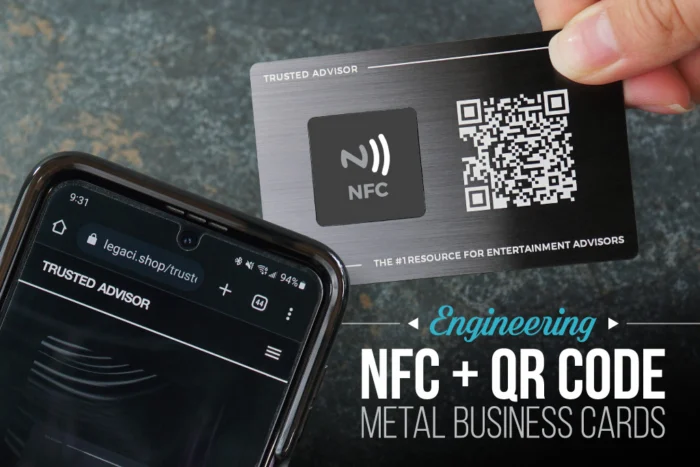
Make Every Tap and Scan Feel Polished, Premium, and Prepared
A metal NFC business card should do more than look impressive. It should help you create a memorable connection in the moment. At a summer conference, rooftop event, product launch, or high-end networking event, the goal is simple: hand someone your card, guide them to tap or scan, and make the experience feel smooth, intentional, and polished.
That said, a metal NFC business card works differently than plastic NFC cards. Metal is beautiful, durable, and premium, but it also affects how NFC signals behave. A metal card may need to be tapped in a more specific spot or held at the right angle for the phone to read it properly. That does not mean the card is not working. It simply means the material requires more thoughtful design and a little more awareness when using it.
We build our cards with that reality in mind. From antenna placement and tap zones to QR code contrast and protective coatings, every detail is designed to make the experience as reliable and intuitive as possible. In this article, we will walk through how NFC works with metal, why positioning matters, how QR codes support the experience, and how we test cards for real-world use before they leave our shop.
Our goal is not to promise magic. Our goal is to help your card perform beautifully in the real world, with the right expectations and the right design behind it.
How NFC Works When Your Card Is Made of Metal
NFC is a short-range wireless technology. Your metal NFC business card and a phone communicate when they are very close to each other, usually within a couple of inches. That close distance is called the read range.
With plastic or paper NFC cards, the antenna usually has more freedom to communicate with the phone. Metal is different. Because metal is conductive, it can interfere with the magnetic field that NFC relies on. If an NFC antenna is placed directly against a solid metal card without proper planning, the metal can:
- Shorten the read range
- Shift the antenna away from its ideal frequency
- Make the card harder to read from certain angles
- Block the signal almost completely in poorly designed cards
That is why metal NFC business cards require more engineering than standard NFC cards. The antenna, chip placement, spacing, and shielding all matter. We treat those details as part of the card’s core design, not as an afterthought.
It is also important to understand that different phones read NFC differently. Some phones have stronger readers than others. Some place the NFC reader near the top of the phone, while others place it closer to the center or camera area. Phone cases, grip accessories, wallets, and even the angle of the tap can affect how quickly the card reads.
For that reason, a metal NFC business card is not always a “tap anywhere and instantly connect” product. It performs best when the recipient taps the correct area of their phone to the correct area of the card. The experience can still feel smooth and impressive, but it works best when the interaction is guided.
Why Positioning Matters With a Metal NFC Business Card
With a metal NFC business card, positioning is one of the most important parts of performance. The card is designed with a specific NFC tap zone, and that zone needs to line up with the phone’s NFC reader.
Most of the time, this means holding the card near the upper back area of the phone, especially on many modern smartphones. However, every phone model is slightly different. Some read best near the camera area. Others may need the card closer to the middle or top edge.
This is why we encourage customers to think of NFC as a guided interaction. Instead of simply handing someone the card and hoping they tap the right spot, the best experience is often:
“Tap the top of your phone here.”
That small cue can make a big difference. It turns a potentially awkward moment into a confident one. You are not explaining around a problem; you are guiding someone through a premium feature.
We design our metal NFC business cards to make that guidance easier. Depending on the card design, the tap zone can be subtly worked into the layout through an icon, logo placement, pattern, or visual cue. It does not have to feel technical or obvious. It just needs to help the person know where to tap.
Behind the scenes, we think about:
- Where the NFC chip and antenna should sit
- How the metal body affects signal movement
- How the tap zone lines up with the card design
- How people naturally hold and present a card
- How different phones and phone cases may affect the read
The goal is to make the card as intuitive as possible while still being honest about how metal NFC business cards work. Metal adds weight, presence, and durability, but it also requires more precision than plastic. When the card is designed well and used correctly, the tap experience can still feel sharp, modern, and memorable.
Setting the Right Expectation: NFC Is Powerful, Not Perfect
NFC is an impressive feature, but it is not always instant in every situation. This is especially true with metal NFC business cards.
A card may read quickly on one phone and take an extra second on another. It may work best without a thick case, or it may need to be moved slightly to find the phone’s reader. In busy environments, people may be moving, holding drinks, using protective cases, or tapping at an awkward angle. All of those details can affect the experience.
That is why we believe realistic expectations are part of great design.
A metal NFC business card should not be treated like a disposable tech gimmick. It is a premium networking tool. Like any premium tool, it performs best when you know how to use it. Once you understand the tap zone and how to guide the interaction, it becomes easy to make the experience feel intentional.
A simple phrase like “tap the top of your phone to this side” can make the difference between a hesitant scan and a confident connection.
This does not take away from the metal NFC business card’s impact. In fact, it can enhance it. When someone sees the weight, finish, and craftsmanship of the card, then taps it and lands on your profile, website, contact page, or portfolio, the experience feels considered from start to finish.
Why We Recommend Pairing NFC With a QR Code
Because NFC depends on phone model, settings, case thickness, and tap placement, we strongly recommend pairing NFC with a QR code. The QR code gives every recipient a backup way to connect.
Some people keep NFC turned off. Some use older phones. Some may not know where their phone’s NFC reader is. Others may be in a loud, crowded setting where scanning a code is simply easier than finding the right tap position.
That is why combining NFC and QR creates the strongest overall experience.
NFC gives you the modern, interactive tap moment. QR gives you universal accessibility. Together, they make sure your card can work for more people, in more environments, with fewer interruptions.
For a QR code to scan well on metal, a few things have to be right:
- Strong contrast between dark and light areas
- A clean quiet zone around the code
- Enough size for a normal phone camera distance
- A finish that does not create too much glare
Metal makes QR design more complex. Mirrored or polished surfaces and color fills can all affect how light reflects off the card. A QR code that looks beautiful in studio lighting may be harder to scan outside in direct sun or under bright event lighting.
That is why we pay close attention to contrast, placement, finish, and coating. Matte finishes often help reduce glare. Color choices matter because cameras need a clear difference between the code and the background.
The QR code should feel like part of the design, but it still has a job to do. We make sure it looks premium while staying practical.
Designing for Real-World Networking
Metal cards live in real life, not in perfect product photos. They sit in wallets, slide against keys, get handled at events, and move between pockets, bags, tables, and phone cases. Over time, scratches, fingerprints, glare, and wear can affect both appearance and functionality.
That is why we think beyond the first impression. We also think about how the card will perform after repeated use.
We consider:
- How the NFC area holds up to normal handling
- How the QR code maintains contrast over time
- How coatings resist scratches, fading, and moisture
- How the card performs with different phones and cases
- How the design guides the recipient toward the right tap zone
Durability matters because the card is only impressive if it continues to look and function the way it should. A beautiful card that becomes hard to scan after a few weeks is not doing its job. A functional card that looks ordinary is not making the kind of statement metal is meant to make.
The balance is both technical and visual. We want your card to feel substantial, refined, and memorable while still giving recipients a practical way to connect with you.
How to Get the Best NFC Tap Experience
The best results usually come from a simple, confident interaction. When handing someone your metal NFC business card, guide them toward the tap zone rather than assuming they know where to place their phone.
For most phones, start by placing the NFC area of the card near the upper back of the phone. Hold it there for a moment instead of quickly swiping or waving the card. If it does not read immediately, move slightly toward the top edge, camera area, or center of the phone.
A few tips can help:
- Hold the card steady for a second
- Tap near the phone’s NFC reader area
- Avoid waving the card too quickly
- Remove very thick cases if needed
- Use the QR code when NFC is not the easiest option
This is not about making the process complicated. It is about understanding how the technology works so the experience feels smoother. Once you know the right motion, it becomes natural.
The best metal NFC business cards are not the ones that pretend material limitations do not exist. They are the ones designed around those limitations so the final experience still feels elevated.
From Concept to Card: Making Smart Networking Feel Intentional
A metal NFC business card is a premium product with smart technology built in. It offers weight, durability, presence, and a modern way to share your information. But because it is made of metal, it requires more careful design and slightly more precise use than a standard plastic NFC card.
We believe customers should know that upfront.
At My Metal Business Card, we do not want to overpromise or make NFC sound effortless in every possible situation. Instead, we focus on building metal NFC business cards that are thoughtfully engineered, beautifully finished, and easy to use once you understand the tap zone.
Sometimes NFC will be the hero of the interaction. Sometimes the QR code will be the fastest path. Most of the time, having both gives you the best chance of making the connection without friction.
We do not make throwaway networking tools. We build cards that feel intentional from the first glance to the final tap or scan. Every antenna placement, QR code, coating, and design choice is part of making your card perform as well as it looks.
You bring the brand, the moment, and the conversation. We build the metal NFC business card that helps that introduction feel polished, premium, and prepared.
Stand Out With a Smart, Premium Business Card
Upgrade to a custom metal NFC business card that combines luxury craftsmanship with practical smart technology. At My Metal Business Card, we help you create a card that looks unforgettable, supports tap and scan sharing, and sets the right expectations for real-world use.
Whether you want NFC, a QR code, or both, we will guide you through the design, production, and setup process so your card is built for the way people actually network.
If you have questions or need help getting started, contact us today.