

NFC vs QR Code Business Cards: Which Digital Option Is Best for Your Business?
NFC business cards offer superior user experience with one-tap contact sharing and unlimited reprogramming, while QR code cards provide universal compatibility at a lower cost. For professionals seeking maximum impact and flexibility, NFC technology delivers 34% more follow-up meetings and 98% connection success rates compared to QR codes’ 85-90% scan reliability.
You’re at a networking event, and while everyone else fumbles with their phones trying to scan QR codes under dim lighting, you simply tap your card to someone’s phone. Your complete contact information transfers instantly. That’s the power of choosing the right digital business card technology.
Quick Comparison: NFC vs QR Code Cards
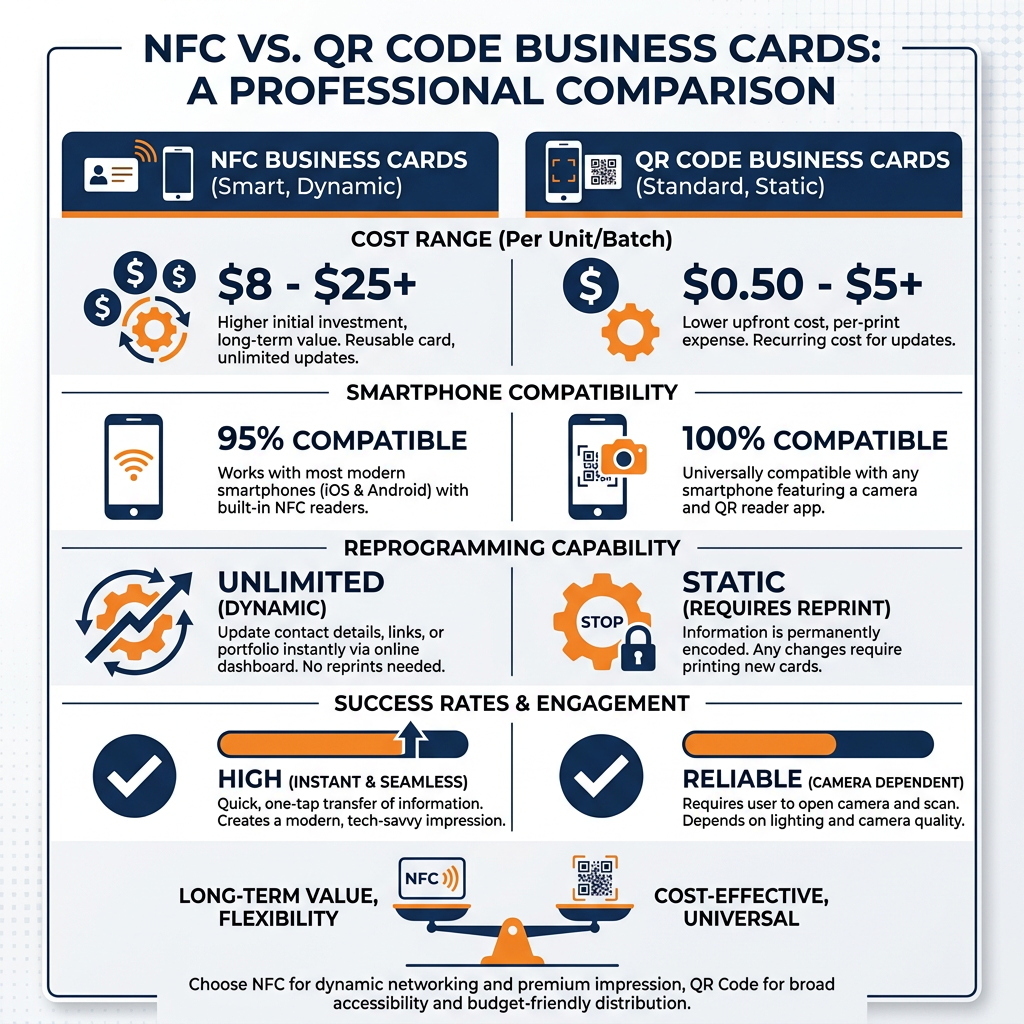
- NFC: Premium experience, one-tap sharing, reprogrammable, 98% success rate, $8-25 per card
- QR Code: Universal compatibility, budget-friendly, static once printed, 85-90% success rate, $0.50-5 per card
- Range: NFC works within 1-4 cm, QR codes scan from 3-10 feet
- Best For: NFC for executives and premium branding, QR for mass distribution and marketing
- Smartphone Support: 95% for NFC (2018+ devices), 100% for QR codes
What Exactly Are NFC and QR Code Business Cards?
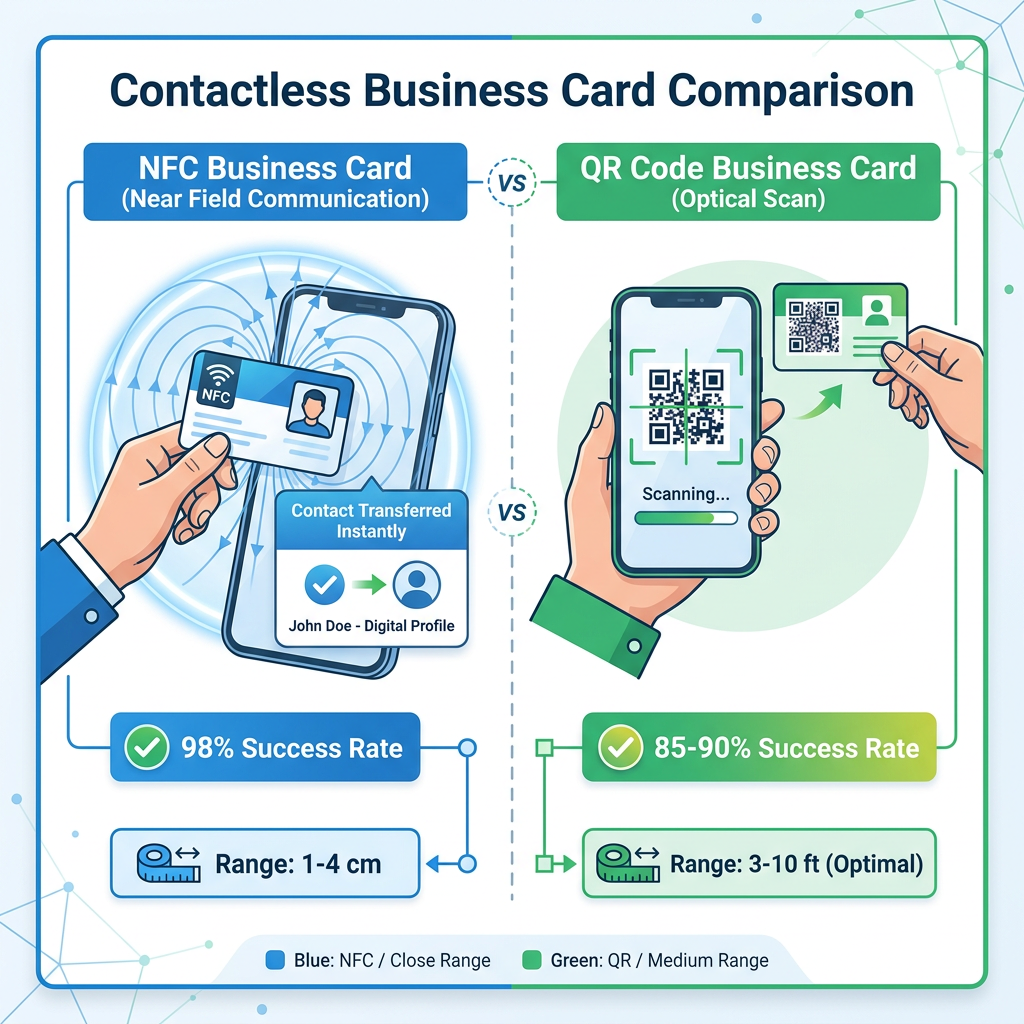
NFC (Near Field Communication) business cards contain a tiny chip that transfers your contact information when someone taps their smartphone against your card. It’s like magic, one tap and your details instantly appear on their phone.
QR code business cards feature a printed square pattern that people scan with their phone’s camera. The code redirects them to your digital contact information, website, or any online destination you choose. Both technologies turn your physical card into a digital gateway, but they work in completely different ways and create vastly different experiences.
How Does NFC Technology Work for Business Cards?
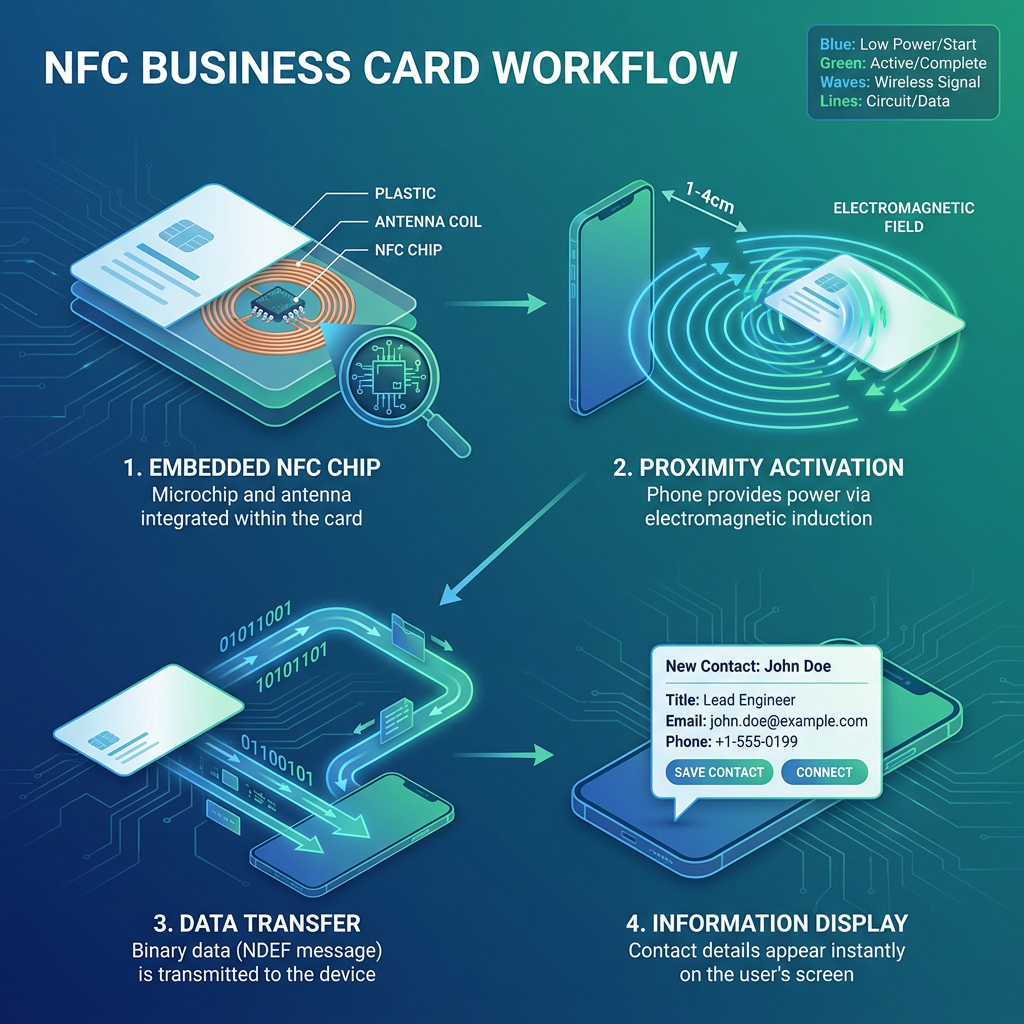
NFC operates through electromagnetic induction between two devices placed within 1-4 centimeters of each other. Someone taps their NFC-enabled phone to your metal NFC business card, and the phone’s NFC antenna powers the passive chip in your card. It instantly reads the stored data.
The brilliant part? Your NFC card needs no battery or power source. The technology can store up to 8KB of data and trigger 12+ different smartphone actions: saving contacts, opening websites, connecting to WiFi, sending pre-written emails, or even launching specific apps.
You can reprogram your NFC card unlimited times. Change jobs? Update your card remotely without reprinting. New website? Update it in seconds through your phone.
How Do QR Code Business Cards Function?
QR codes work through visual recognition. Your phone’s camera captures the printed pattern and decodes the embedded information, typically a URL that redirects to your digital profile or contact page.
The advantage? QR codes work with 100% of smartphones since every device has a camera and QR scanning capability built into the standard camera app. No special hardware required.
However, QR codes are static once printed. Want to change your information? You’ll need new cards. This makes business cards with QR codes better suited for information that won’t change frequently.
Which Technology Offers Better User Experience?
Here’s where NFC truly shines. Professional networking studies from 2026 show NFC cards generated 34% more follow-up meetings compared to QR code alternatives. Why? The user experience is seamless.
No opening camera apps, no adjusting angles or fighting with lighting, no waiting for redirects to load. Just tap and done.
QR codes create friction. Your contact needs to open their camera app, point it at your card, hold steady while it focuses, wait for the scan to register, tap the notification to open the link, then wait for the webpage to load.
That’s six steps versus NFC’s single tap. In fast-paced networking environments, this difference matters enormously.
Cost Analysis: NFC vs QR Code Business Cards
QR code business cards typically cost $0.50-5 per card, depending on materials and printing quality. Aluminum business cards with QR codes might run $2-4 each.
NFC business cards range from $8-25 per card, with premium metal NFC business cards at the higher end. Yes, that’s 3-5 times more expensive upfront.
But here’s the ROI calculation most people miss: if your NFC card generates just one additional high-value client or business relationship, it pays for itself dozens of times over. When you factor in the reprogrammability (no need for reprints when information changes), the long-term cost difference shrinks significantly.
For high-stakes business development, the premium investment makes sense. For mass marketing campaigns where you’re distributing hundreds of cards, QR codes win on economics.
Smartphone Compatibility and Technical Requirements
About 95% of smartphones manufactured after 2018 include NFC capability, but not everyone has it enabled. Some users turn off NFC to save battery life or for security concerns.
QR codes work with 100% of smartphones through standard camera apps. No special settings required.
However, NFC compatibility is rapidly approaching universal adoption. By 2026, virtually all new smartphones include NFC, and user awareness has grown dramatically. The “Does my phone support this?” question is becoming increasingly rare.
Security Considerations: Which Is Safer?
NFC wins the security battle decisively. The technology supports encryption and secure data transfer protocols. Since it operates over such short range (1-4 cm), it’s virtually impossible to intercept communications without physical access to both devices.
QR codes are vulnerable to several attack vectors. Malicious actors can place stickers with harmful QR codes over legitimate ones. Fake QR codes can redirect to phishing sites. There’s no way to verify destination before scanning.
For professionals handling sensitive client information or operating in security-conscious industries, NFC’s built-in protection provides peace of mind.
Durability and Longevity on Metal Cards
Metal cards provide the perfect platform for both technologies, but each presents unique considerations.
NFC chips embedded in metal cards maintain 99.7% functionality after 10,000 tap cycles, according to 2026 durability testing. The metal construction actually protects the chip better than plastic alternatives.
QR codes printed or laser-etched on metal show remarkable durability. Unlike paper cards where QR codes can fade or smudge, metal preserves the code pattern indefinitely. Proper contrast between the QR code and metal background ensures reliable scanning even after years of use.
Industry-Specific Recommendations
Real Estate Professionals: NFC cards excel here. Instantly share property listings, virtual tour links, and contact information. The premium perception aligns with high-value transactions.
Technology Companies: NFC demonstrates innovation and tech-savviness. Perfect for startups and established tech firms wanting to showcase cutting-edge adoption.
Legal and Financial Services: NFC’s security features and professional image suit these trust-based industries. The seamless experience impresses clients accustomed to premium service.
Marketing and Events: QR codes work better for mass distribution. Lower cost allows broader campaigns, and universal compatibility ensures no missed connections.
Healthcare Professionals: Consider hybrid cards with both technologies. NFC for colleagues with compatible devices, QR codes as backup for universal access.
The Hybrid Approach: Best of Both Worlds
Smart professionals increasingly choose metal business cards featuring both NFC and QR code technologies. This hybrid approach covers all bases.
NFC handles premium contacts and tech-savvy professionals. QR codes serve as backup for older devices or NFC-disabled phones. You get maximum compatibility without compromising on innovation.
While this increases cost, the comprehensive coverage often justifies the investment for serious business development efforts.
Programming and Customization Options
NFC cards offer incredible flexibility. You can program them to save complete contact information, open specific websites, connect visitors to your WiFi network, launch social media profiles, send pre-written emails, or share calendar links for easy appointment booking.
The game-changer? Update any of these actions remotely through smartphone apps. Your card stays current without reprinting.
QR codes, once printed, remain static. Want to change the destination URL? You need new cards. This limitation makes them better suited for stable information like company websites or permanent contact pages.
Making Your Decision: Which Technology Fits Your Goals?
Choose NFC if you want maximum impact and premium perception, need flexibility to update information regularly, work in high-value relationship-based industries, have budget for premium materials, or target tech-savvy professional networks.
Choose QR codes if you need broad distribution at lower cost, have stable contact information that rarely changes, work in volume-based sales or marketing, want universal smartphone compatibility, or prefer simpler technology with fewer variables.
Choose both if you want comprehensive compatibility, work in diverse professional environments, can justify premium investment for maximum networking effectiveness, or value having backup options for any situation.
Future-Proofing Your Business Cards
NFC adoption continues accelerating. Apple Pay and Google Pay have normalized NFC usage, making professionals more comfortable with the technology. By late 2026, NFC business cards feel natural rather than novel.
QR codes remain relevant for mass marketing and universal compatibility scenarios. The technology is mature, reliable, and cost-effective for appropriate use cases.
The smartest approach? Start with your primary networking goals and budget, then choose the technology that best supports your specific business development strategy.
Frequently Asked Questions
Can I update my NFC business card without reprinting? Absolutely. NFC cards can be reprogrammed unlimited times through smartphone apps. Change your contact info, website, or any programmed action remotely in seconds.
What if someone’s phone doesn’t support NFC? About 5% of smartphones lack NFC capability. Consider hybrid cards with both NFC and QR codes, or have a backup method like a traditional card or verbal contact sharing.
Are metal QR codes harder to scan than paper ones? Not with proper design. High contrast between the QR code and metal background ensures reliable scanning. Laser-etched QR codes on metal often scan better than printed paper versions.
How many times can I tap an NFC business card before it stops working? Testing shows metal NFC cards maintain 99.7% functionality after 10,000 taps. Normal business use won’t wear out the technology.
Can I track who scans my digital business card? Yes, both technologies can include analytics. NFC cards and QR codes can redirect to landing pages with tracking capabilities, showing scan frequency, location, and timing data.
Which option works better at networking events? NFC typically performs better in networking environments due to speed and ease of use. However, QR codes work well when you have good lighting and people aren’t rushing between conversations.